

Your first 100 days as a marketing manager: a roadmap from assessment to first campaign
A three-phase roadmap for anyone who just took over marketing: the assessment, the connected tools and the first campaign, with milestones leadership understands and the full whitepaper to download.

Your first 100 days as a marketing manager work best in three phases: diagnose the operation in days 1 to 30, connect tools and processes in days 31 to 60, and run, test and measure in days 61 to 100. Each phase ends with a milestone leadership can see, and that is what turns a rushed start into a plan you can defend with numbers.
The pressure is real. In RD Station's 2026 Marketing and Sales Panorama, a survey of Brazilian companies, 73% of marketing teams with defined goals said they did not reach their 2025 objectives. Below is the roadmap we wrote at Mtools for people who just took the job, moved to a new company or want to restart the cycle with a method.
Days 1 to 30: the marketing assessment
The first month is for understanding reality before promising anything. A new marketing manager who launches campaigns before measuring risks repeating the predecessor's mistakes. One who starts by measuring finds where the hidden results are and where the waste is.
An audit on three fronts
Map tools, processes, metrics, team and results from the last 12 months. The data always brings surprises, even for people who think they know the place. Look at three fronts:
- Real performance in the previous year: which channels delivered, which months had peaks in traffic or conversion and which campaigns were running then, with no vanity metrics.
- Team capabilities: each person's strengths and gaps, so you know what can be done in-house and what needs support.
- Data and automation infrastructure: what is measured, where the data lives and whether marketing and sales look at the same numbers.
3 to 5 metrics for the C-suite
Pick a few metrics, and pick the ones leadership already uses to make decisions. Impressions and click-through rate help the team day to day, but they won't carry a budget conversation. The candidates:
- CAC (customer acquisition cost);
- pipeline generated by marketing;
- cost per qualified lead;
- LTV of customers who came from marketing;
- payback period on acquisition spend;
- sales velocity and retention rate, when marketing influences those stages.
To turn those numbers into a report leadership actually reads, see how to build marketing metrics for leadership.
The real journey and who makes the decision
Build the journey from behavioral data, the CRM and conversations with sales. Find out how your best customers discovered the company, compared options and signed. Call recordings and recurring meetings with sales reveal the questions that keep coming up.
In that map, record who takes part in the decision. When you sell to other companies, the buying committee usually brings together people with different questions, and each of them needs different content.
Tracking before campaigns
Without reliable tracking, no result from the next 70 days will convince anyone. Still in the first month:
- standardize UTMs and campaign parameters;
- set up dashboards that connect marketing to sales;
- implement tracking in line with privacy law (LGPD, in Brazil);
- create an executive report with the chosen metrics;
- schedule a weekly analysis meeting.
An internal committee for the plan
Bring together people from sales, product, customer success and finance. With them, align timelines and investment, define the quick wins for the quarter, build the schedule and present the plan to leadership. Involving other areas early raises the odds that the plan leaves the drawing board.
Days 31 to 60: connected tools and processes
The second month puts the pieces together: tools that talk to each other and processes that don't depend on anyone's memory. Prioritize the connections between CRM, marketing automation, analytics and paid media platforms. A lead that disappears between two tools is a result marketing can't prove.
Connecting those sources in a single dashboard is part of the work we do in data and dashboards when the team doesn't have the hands for it.
 Talk to usWant help planning this at your company?Tell us what you need. We'll reply by email or WhatsApp and, if it makes sense, put together a quote.Contact us
With the tools in place, document and automate whatever repeats. Templates for briefs, approvals, reports and analysis free up hours for creative and strategic work, and a good marketing brief template prevents much of the rework. In the same period:
- review the paid media campaigns already running;
- run A/B tests on your main landing pages;
- improve conversion in the flows that bring the most leads;
- start a lead nurturing program.
Days 61 to 100: campaigns, tests and automation
The third phase puts the plan into the market and compares results with the metrics from month one. Launch campaigns that connect your touchpoints, with messages tuned to the behavior of each group of leads. Cut quickly what doesn't perform and move budget to what shows results.
Set aside part of the effort to experiment:
- two new channels with potential for your persona;
- content formats the team hasn't tried yet;
- technical SEO improvements;
- segmented email marketing.
Close the phase with automation. Connect channels such as email and WhatsApp, create playbooks for recurring campaigns and implement lead scoring by profile and interest, so sales gets the people closest to buying first. The step-by-step for lead scoring in RD Station helps you build the model.
The milestones of a 100-day plan
Each milestone is a deliverable you can show in a meeting, no justification slide needed.
| Milestone | What needs to be ready |
|---|---|
| Day 30 | Primary metrics approved by leadership, targets set and the roadmap for the next 70 days validated |
| Day 60 | Tools connected and working, processes documented, team trained and the first integrated campaign live |
| Day 90 | Measurable improvement in at least two primary metrics, less team time on operational tasks and the plan for the following months approved |
The mistakes that derail your first 100 days as a marketing manager
The most expensive mistakes come from rushing. Four show up often:
- Changing everything at once. Pick two or three fundamental changes at a time and move in cycles.
- Ignoring internal resistance. Communication and training matter as much as strategy. Explain the why before the how.
- Not documenting. Insights, tweaks and lessons that live in someone's head are lost at the first team change.
- Betting only on tools. Technology amplifies a strategy that already exists. Define the goal before signing up for the next platform.
What to do on day 101
Day 101 starts the routine that carries the rest of the year. Schedule a monthly performance review, keep a fixed budget for tests and stay close to sales, product and finance. Keep investing in the team, because tools and channels change fast.
It is also the time to turn what you learned in 100 days into your marketing plan for 2027, with targets, budget and priorities backed by your own operation's data.
What's inside the whitepaper
The full material takes the roadmap above into detail, with practical checklists for each challenge. It was written for the start of 2026, and the method works for any start: a new role, a new company or a new cycle. It is in Portuguese. Inside:
- the seven beliefs that hold marketing managers back, from “marketing is a cost” to “you can't prove ROI on branding”, and how to answer each one;
- the full 100-day roadmap, with the milestones for days 30, 60 and 90;
- the hardest challenges of the role (measuring impact on sales, combining creativity and data, depending less on paid media, building teams that work with AI, handling pressure for immediate results, channel fragmentation and privacy rules), each with a checklist;
- the five types of tools that support the plan;
- the mistakes to avoid and the routine from day 101 on.
If you are in your first 100 days as a marketing manager, or about to start, use the checklists as the agenda for your first meetings with leadership and with the team.
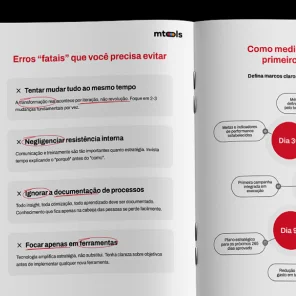 Support material · Whitepaper in PortugueseThe first 100 days as a marketing managerA roadmap from diagnosis to the first campaign, with the metrics the board understands.Download the whitepaper
Frequently asked questions
What should I do in my first 100 days as a marketing manager?
Assess the operation in the first month (audit, metrics, journey, tracking and alignment with other areas), connect tools and processes in the second, and run, test and measure in the third. Each phase ends with a milestone leadership can evaluate.
Which metrics should I show leadership in the first months?
Three to five business metrics, such as CAC, pipeline generated by marketing, cost per qualified lead, LTV and payback period. Channel metrics remain useful for the team but stay out of the leadership conversation.
Does a 100-day plan work in the middle of the year?
Yes. The roadmap was designed for the start of the year, but the logic of assessing, organizing and executing works for any start, including a new role in October.
Do I need a big budget to follow the roadmap?
No. Most of the first month depends on time and organization, and measurement and automation tools come in affordable plans. Budget matters more in the third phase, when campaigns already have metrics to prove the return.